
Each week, MarketFIT™ from Express Freight Finance analyzes real-time freight market data to surface the most favorable and competitive markets across the country.
Rather than reacting to yesterday’s trends or generic load board averages, MarketFIT helps carriers and brokers make smarter decisions in the moment — from where to drive next, to how to price lanes, to when to push for stronger rates.
MarketFIT Platform Overview
With MarketFIT, Express Freight Finance clients gain access to in-depth dashboards covering 125+ U.S. markets and thousands of active freight lanes, all updated continuously to reflect real-world conditions.
If this is your first time here, watch our short overview below featuring Dan Hadley, President & CEO of Express Freight Finance, to see how MarketFIT turns raw data into actionable strategy inside your business.
What This Week’s Data Shows
Below is a snapshot of this week’s live MarketFIT data, highlighting key shifts in demand, capacity, and pricing across top U.S. freight markets.
Shreveport, LA records a moderate week-over-week improvement, with the Overall Fit Score increasing by 3.17 points to 27.94, indicating a slight strengthening in freight market conditions. While the market is improving, it remains relatively soft compared to stronger headhaul markets, suggesting only gradual momentum.
Outbound Tender Volume stands at 57.8, slightly below Inbound Tender Volume at 60.4, resulting in a Head Haul Index of -2.6. This positions Shreveport as a mild backhaul market, where inbound capacity slightly exceeds outbound demand. This imbalance suggests looser conditions, with more trucks entering the market than leaving, which can limit carrier leverage.
The Outbound Tender Reject Index (OTRI) is at 28.57, indicating relatively elevated rejection activity. Despite the backhaul imbalance, carriers are still showing selectivity, which may point to pockets of tightening or rate sensitivity within specific lanes.
Overall, Shreveport reflects a market in transition, with improving conditions but still characterized by a slight backhaul imbalance. Elevated rejection levels suggest some underlying tightening, though the excess inbound capacity may continue to temper significant upward pressure on outbound rates in the near term.
The Outbound Tender Reject Index (OTRI) is elevated at 30.83, highlighting a high level of carrier rejection activity. This suggests carriers are becoming more selective and prioritizing higher-yield freight, reinforcing the tightening capacity environment.
Overall, Texarkana is showing clear signs of a tightening market driven by a strong headhaul imbalance and elevated rejection levels. With an improving Fit Score and increasingly favorable outbound dynamics, the market is likely to see continued carrier leverage and potential upward pressure on outbound rates if these trends persist.


Carriers Continue To Ramp Up Profits With These Lanes:
- Chicago, IL → Detroit, MI - Avg. Rate per Mile: $3.69
- Ontario, CA → Phoenix, AZ - Avg. Rate per Mile: $3.68
- Joliet, IL → Cincinnati, OH - Avg. Rate per Mile: $3.41
These lanes remain well-supported as pricing stays firm across established Midwest and Northeast freight corridors.

Load Availability & Lane Rates Intelligence
Zero in on where freight is actually moving right now — highlighting lanes with rising demand, tightening capacity, and improving rate potential.
Use this MarketFIT data to spot pockets of opportunity as they emerge, compare lanes side by side, and prioritize routes that offer the best balance of volume and pricing — before conditions shift.
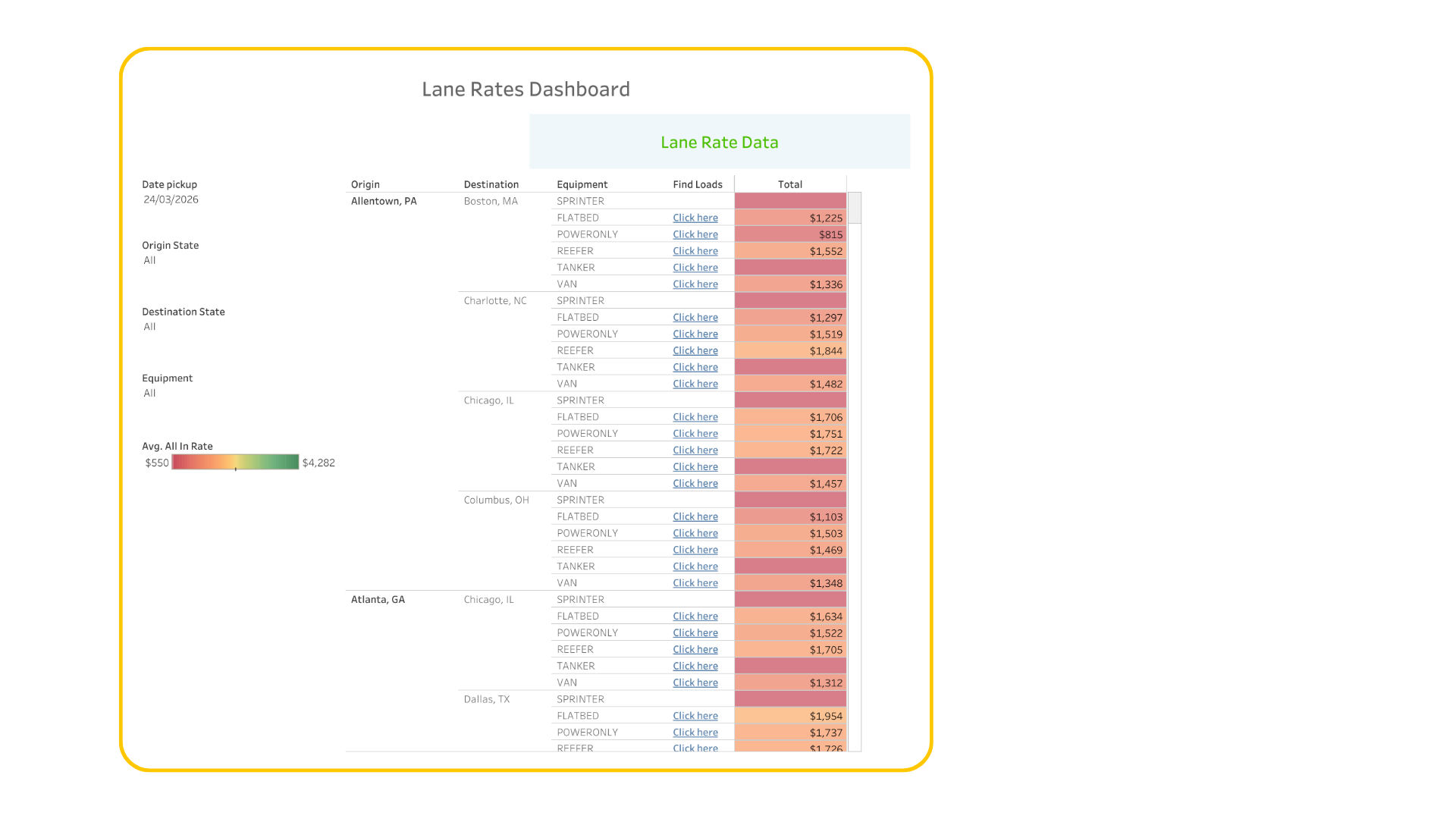
Below is a snapshot of this week’s load availability and lane rate data across key markets.

You can learn more about MarketFIT and request a demo by visiting MarketFIT.