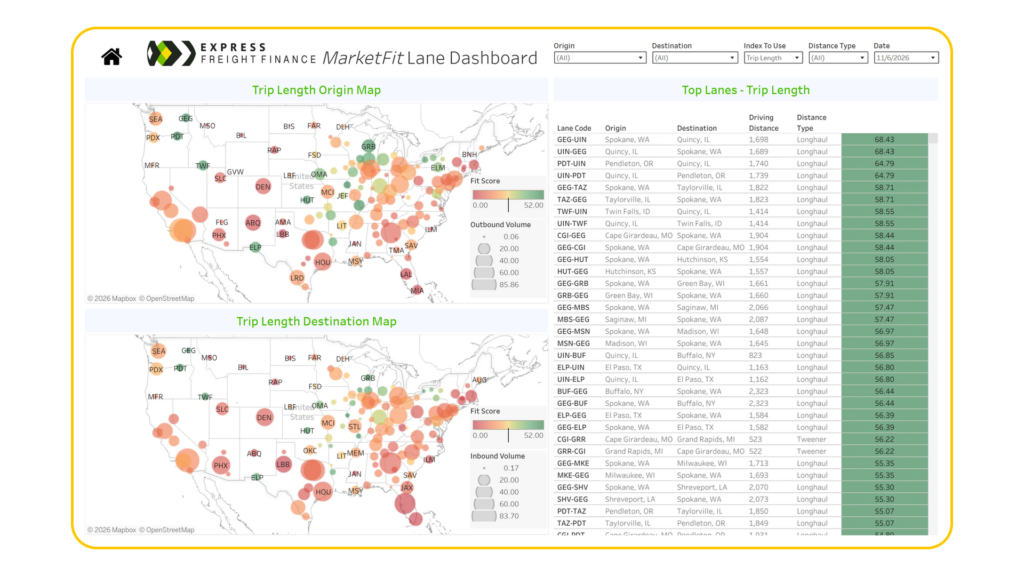
Each month, MarketFIT™ from Express Freight Finance analyzes real-time freight market data to surface the most favorable and competitive markets across the country.
MarketFIT helps carriers and brokers make smarter decisions in the moment, from where to drive next to how to price lanes and when to push for stronger rates.
MarketFIT Platform Overview
With MarketFIT, Express Freight Finance clients gain access to in-depth dashboards covering 135+ U.S. markets and thousands of active freight lanes, all updated continuously to reflect real-world conditions.
If this is your first time here, watch our short overview below featuring Dan Hadley, President & CEO of Express Freight Finance, to see how MarketFIT turns raw data into actionable strategy inside your business.
October in Review
Below is a snapshot of this month’s live MarketFIT data, highlighting key shifts in demand, capacity, and pricing across top U.S. freight markets.
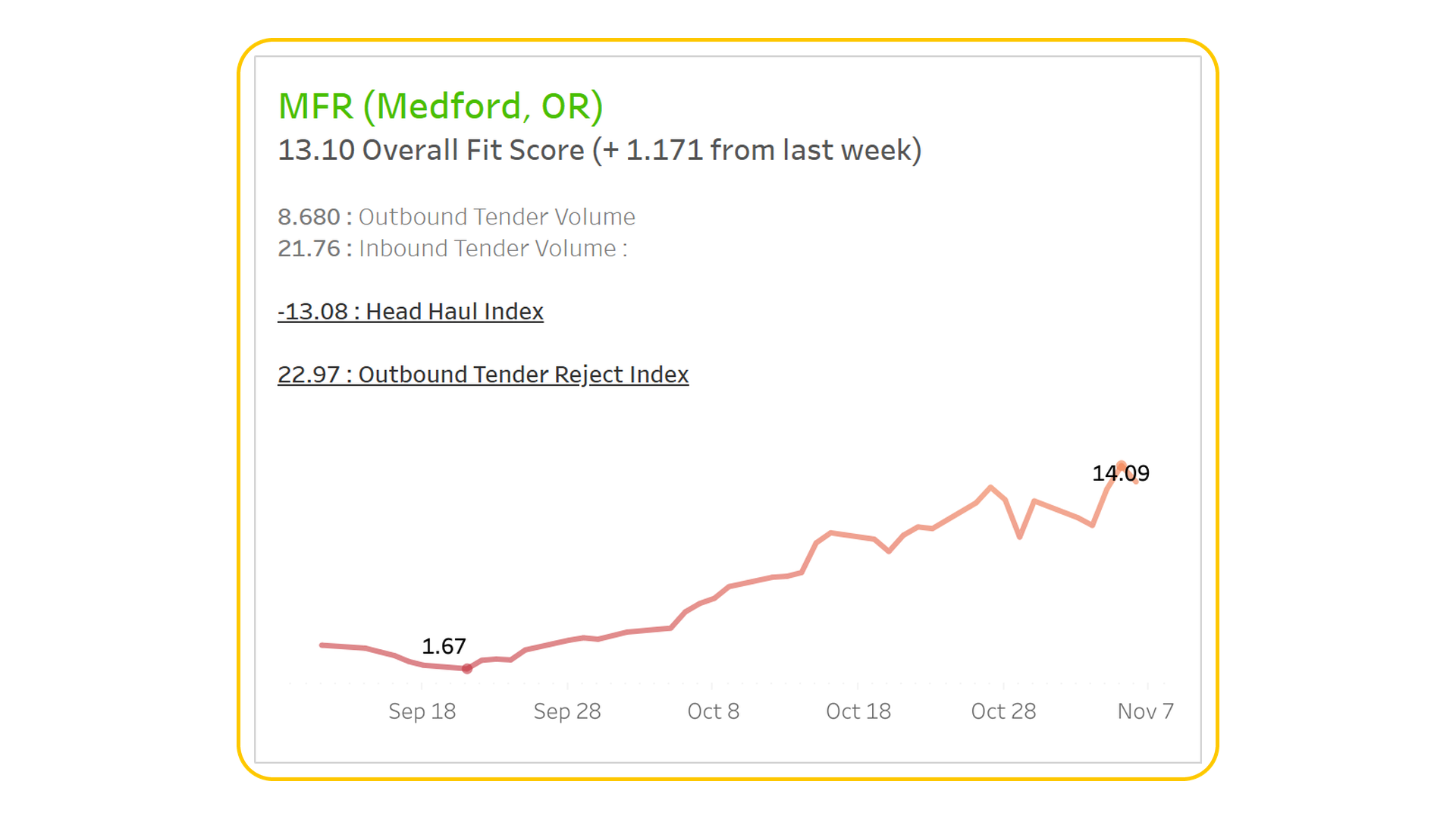
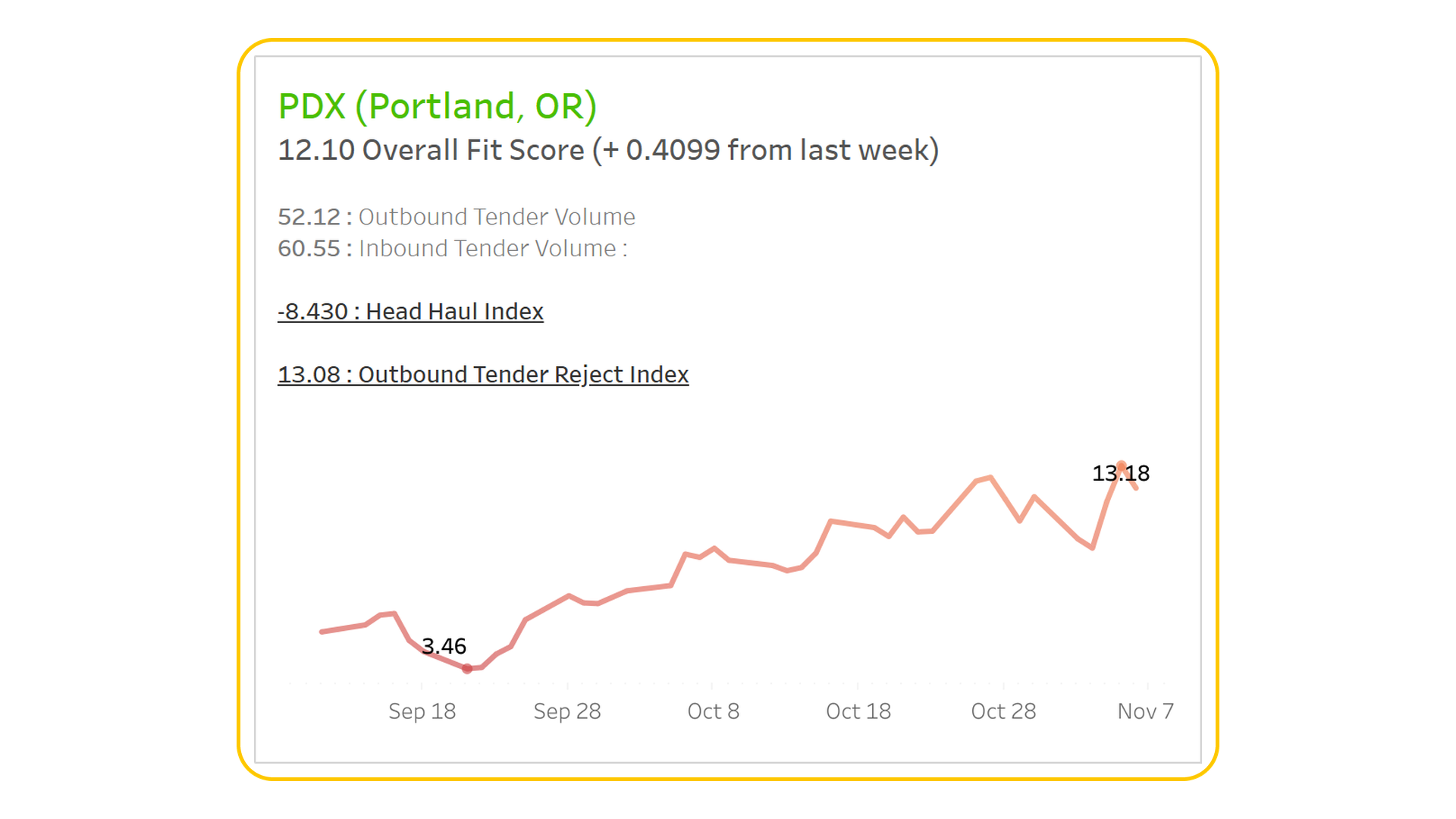
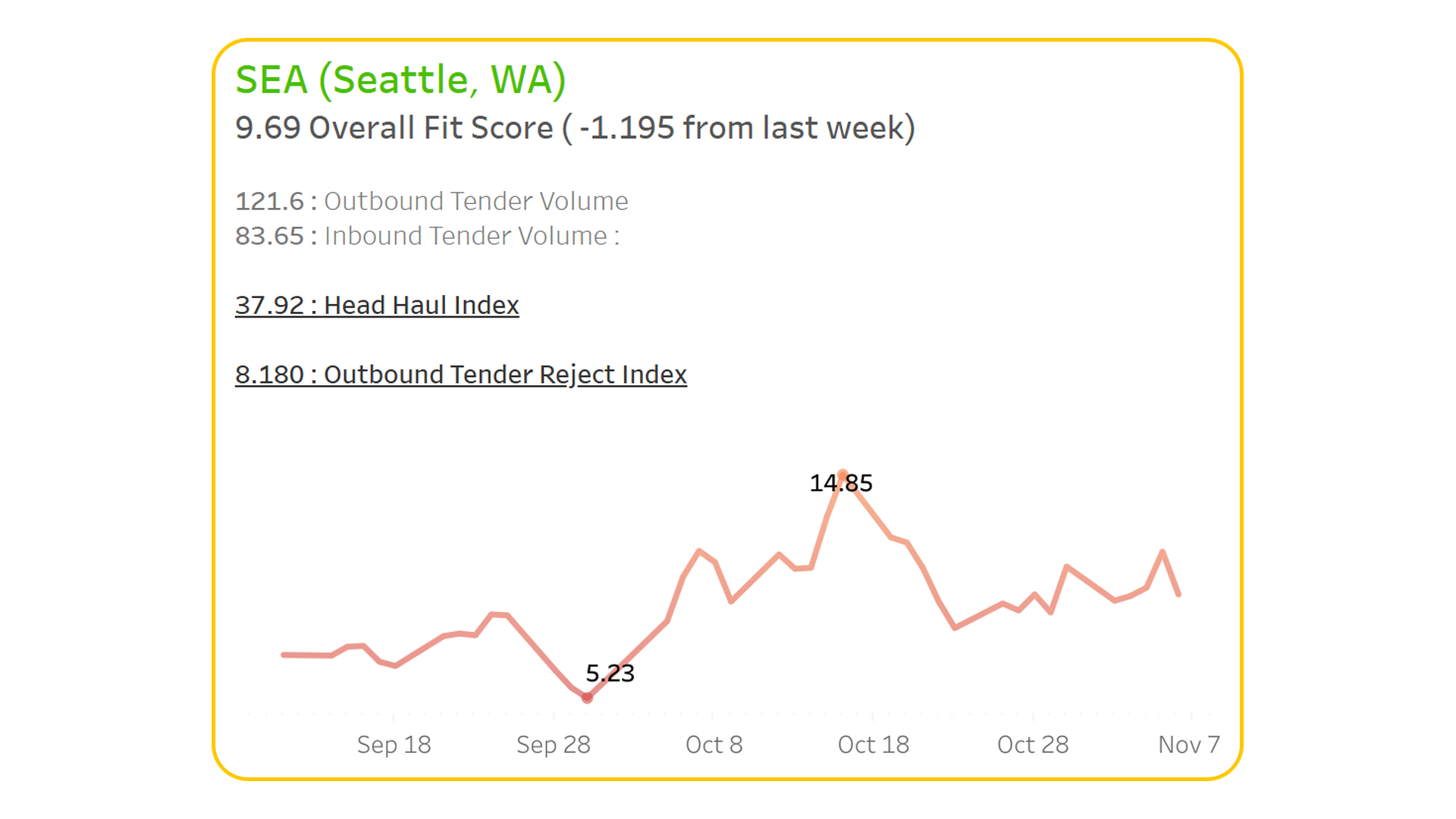
The Pacific Northwest stood out in October. Medford, OR, Portland, OR and Seattle, WA each posted one of the ten largest net Fit Score gains among MarketFIT markets, and all three opened the month at their low on the 2nd before closing higher at month-end. Medford led the region, more than tripling its Overall Fit Score from 3.91 to 11.93, an increase of 8.02 points, with a peak of 12.77 on the 27th. Portland increased by 4.50 points to 11.69 from 7.19, also peaking on the 27th, at 12.62. Seattle increased by 4.35 points to 10.89 from 6.54, after peaking earlier at 14.85 on the 16th and pulling back to 8.24 on the 23rd. The shared climb suggests carrier conditions improved across the region, not just in one market.
The three cities differed on freight direction. Seattle closed the month with outbound tender volume of 101.30 and inbound volume of 82.39, for a +18.91 Head Haul Index. Outbound freight volume exceeds inbound volume, potentially creating greater competition for equipment departing Seattle, and that imbalance may support upward pressure on spot rates. Medford (8.80 outbound vs. 19.13 inbound, a −10.33 Head Haul Index) and Portland (53.88 vs. 57.00, −3.12) closed with more freight arriving than leaving, which may mean more competition among carriers for outbound loads. However, actual equipment availability will depend on carrier positioning, shipment schedules, and lane-specific requirements.
OTRI rose in all three markets. Medford’s climbed from 5.82 to 18.93, meaning carriers rejected nearly one out of every five contracted outbound tenders, and Portland’s rose from 6.99 to 12.03, about one in eight. At those moderate levels, more contract freight may be moving to the spot market. Seattle’s increased from 6.08 to 9.87, still low at about one in ten. Taken together, Seattle paired an outbound surplus with low rejections, while Medford and Portland paired inbound-heavy flows with rising rejections, which may give carriers already in those Oregon markets more room to negotiate on the outbound loads that are available.
For carriers, the month’s takeaway is that the Pacific Northwest became more favorable overall, but the opportunity looks different by city: Seattle offers more outbound freight, while in Medford and Portland, lining up a reload before you deliver may pay off more than waiting for spot loads to appear.
November to Date
Through the 6th, the region split. Medford kept rising: its Fit Score reached 14.09 on the 5th, above its previous peak, and stood at 13.10 at the cutoff, 1.17 points above last month’s close, with OTRI climbing to an elevated 22.97 and its Head Haul Index widening to −13.08. Portland also edged higher, to 12.10, 0.41 points above its close, after reaching 13.18 on the 5th, with OTRI up to 13.08 and Head Haul at −8.43. Seattle eased: its Fit Score slipped to 9.69, 1.20 points below its close, and OTRI fell to 8.18, even as its Head Haul Index roughly doubled to +37.92.
Five business days in, the Oregon markets are carrying last month’s trend forward, led by rising carrier rejections, while Seattle’s outbound surplus has grown without a matching rise in its score. The signal to watch for the rest of November is whether OTRI keeps climbing in Medford and Portland heading into Thanksgiving week, and whether Seattle’s growing outbound volume starts to lift rejections there.
November data pulled through November 6, 2026
Factors to Watch This Month
Diesel is easing but still elevated. The EIA’s national average for on-highway diesel fell 6 cents to $6.29 a gallon for the week of November 2, after reaching $6.35 the week before, and it’s still about $2.54 above a year ago. Check fuel surcharge terms before you book, and price spot quotes on current fuel costs rather than last month’s numbers.
A Southern California port deadline on November 20. Contract talks for port security workers at Los Angeles and Long Beach are still unresolved, and the strike authorization deadline has been pushed back again, to November 20. A strike could slow terminal operations at both ports, so carriers hauling import or drayage freight in the area should confirm appointments that week and keep a backup load in mind for equipment tied to port pickups.
Thanksgiving week shortens the schedule. Thanksgiving falls on November 26, and shippers typically push holiday retail freight out ahead of it, which compresses the work week. Book loads for the week of November 23 early and line up a reload before the long weekend. Theft risk also tends to rise into the holidays, and CargoNet reported that fictitious pickups made up about a quarter of third-quarter theft incidents, so confirm pickup details directly with the broker or shipper before you load.
Winter weather is starting on western mountain passes. November typically brings the first snow and chain requirements to mountain passes in the West, including I-5 over the Siskiyou Summit just south of Medford. Build extra transit time into Pacific Northwest and Northern California loads, carry chains, and check state DOT road conditions before dispatch.
Top Lanes of the Month
Carriers Continue To Find Strong Opportunities With These Lanes:
- Spokane, WA → Quincy, IL (1,698 mi)
- Pendleton, OR → Quincy, IL (1,740 mi)
- Spokane, WA → Taylorville, IL (1,822 mi)
All three are long-haul runs from the Inland Northwest into western and central Illinois, which may give carriers in eastern Washington and Oregon a strong option for moving freight toward the Midwest.